
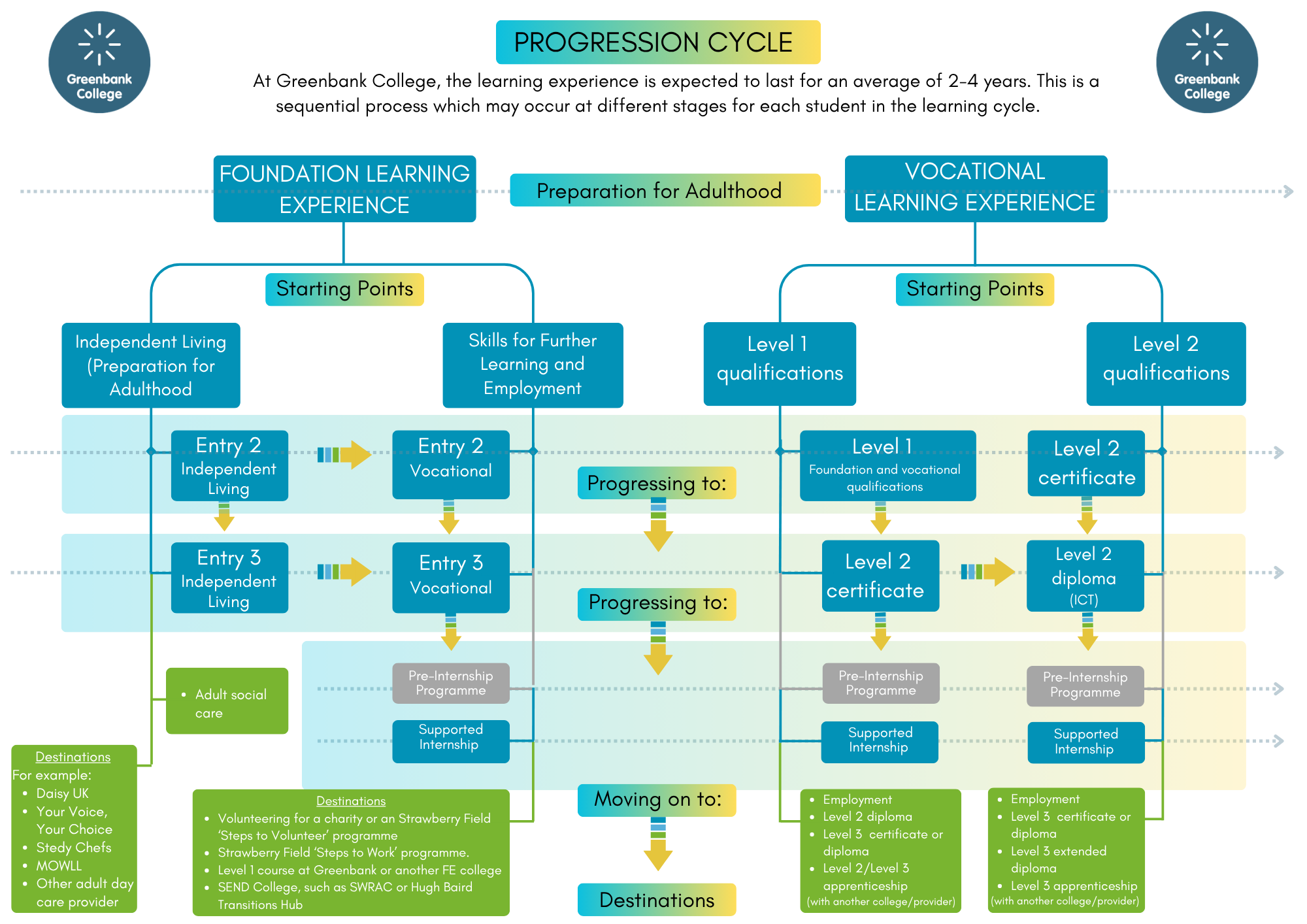
At Greenbank College, the learning experience is expected to last for an average of 1-4 years, depending on the aspirations and starting point of each student.
This is a sequenced process, meaning that learning is planned in the right order so students steadily build deeper, more complex understanding over time.
Here’s a simple way to understand it:
1. It’s like a staircase, not a jump
Instead of expecting students to leap from basic to advanced understanding, learning is broken into steps (sequence). Each step:
- Builds on what came before
- Prepares for what comes next
2. Knowledge and skills are deliberately ordered
Tutorss and curriculum designers decide:
- What to teach first
- What should come next
- When to revisit earlier ideas
This avoids random or disconnected learning.
3. It supports progression (moving forward)
“Progression” means students:
- Deepen understanding
- Gain more independence
- Apply skills in different situations and contexts (i.e. work experience, enrichment and enterprise)
4. It includes revisiting and reinforcing
Good sequencing isn’t just linear. It also:
- Revisits key ideas (to strengthen memory)
- Connects topics together
This helps to embed learning.
5. In post-16 education and training
It often looks like:
- Starting with core foundations
- Moving to specialist knowledge
- Ending with application (e.g. exams, coursework, enterprise, work experience)